We look forward to marching in person with you in Washington, DC on January 21! For indoor events surrounding the March For Life, please keep an eye on our website where we will post updates regarding local covid-related regulations.
Jeanne Mancini Speaks at the Supreme Court Ahead of the Dobbs v. Jackson Women’s Health Organization Oral Arguments
I’m blessed to be the president of the organization that coordinates the largest annual peaceful human rights demonstration every year, the March for Life.
Nearly 49 years ago – on January 22nd, 1973 – our country was forever changed when seven men on the United States Supreme Court handed down the Roe v. Wade decision, forever changing American history by imposing a radical expansion of abortion on all 50 states.
Since that time, we’ve tragically lost more than 62 million American children to abortion, and many mothers and fathers regret having been involved in abortion. When one life is taken through abortion, another is wounded. Many brave women and men have stood here to share their stories of regretting abortion every year at the March for Life.
In response to this injustice, the March for Life began one year after Roe, in Jan 1974. Since that time we have continued to march for life every year in DC and now in the states. Collectively millions of pro-life Americans have marched for life over the years to stand up for the voiceless, the poorest of the poor, the most vulnerable, the unborn.
Much to the dismay of abortion activists pro-life Americans have not become desensitized to abortion, in fact, just the opposite has occurred. The March grows every year and I can’t think of a more tangible or hopeful sign that Roe and Casey are not settled law.
We are all united here today by our common understanding that every life from the moment of conception is precious and deserves legal protection. When it comes to the inherent dignity of every human person, skin color doesn’t matter, disability status doesn’t matter, socioeconomic background doesn’t matter; what matters is the fact that every life is precious and should be protected from the moment of conception/fertilization. Injustice anywhere is a threat to justice everywhere.
Being pro-life is being pro-woman. Choosing life isn’t always easy but it does empower women. At the March for Life we want to empower women with a message that they don’t have to choose between the life of their baby and their own future.
Today I speak on behalf of the millions of Marchers calling for the Supreme Court to protect the inherent dignity of the human person and to empower women to choose life. This is why we march.
It is Time for the Supreme Court to Overturn Roe and Casey
RIGHTING THE WRONGS OF THE SUPREME COURT’S ABORTION RULINGS
For decades, the Supreme Court has restricted states’ abilities to enact laws that protect unborn children and their mothers.
+It is far past time to restore this right to the people and to allow states to update their laws to reflect modern science.
+Thanks to new technology, the humanity of a 15-week-old child in the womb is undeniable. It is time our policies reflect that fact.
In Roe and Casey, the Supreme Court robbed the American people of their say in the laws that govern abortion and prevented elected representatives from acting on the will of the people.
+ With the Dobbs case, the Supreme Court should return the task of determining abortion policy to the people and their elected representatives.
Today, the United States is one of just a handful of countries, including China and North Korea, that allows late term elective abortion.
Roe does not permit the significant restrictions on abortion that consistent polling shows a large majority of Americans (76%) want.
U.S. ABORTION LAWS ARE DRASTICALLY OUT OF TOUCH WITH MODERN SCIENCE
Despite advancements in science and medicine drastically improving our understanding of fetal development and pain, the Supreme Court decisions in Roe and Casey have prevented our laws from being updated to meet our basic moral obligations to the unborn.
Modern advances in science and medicine give concrete evidence to the humanity of a 15-week-old child in the womb.
+ Children at that stage have fully formed noses, lips, eyelids and eyebrows, can suck their thumbs, and can even feel pain.
+ The Charlotte Lozier Institute found “a comprehensive review of the scientific literature including neural development, psychology of pain sensation, and moral implications of fetal pain, concludes that unborn babies may experience pain as early as 12 weeks.”
+ With proper care, extremely preterm infants are surviving at earlier ages than ever before. Ages of survival have dropped from 28 weeks to now less than 22 weeks.
As a result of these scientific advancements, Mississippi enacted the Gestational Age Act in 2018, protecting the dignity of the unborn child, the health of mothers, the integrity of the medical profession and society by restricting abortion after 15 weeks.
After multiple lawsuits and appeals, the law in question has reached the Supreme Court. The state asked the Court to address the fundamental, irreconcilable conflict that new scientific evidence has raised with the Court’s previous rulings.
OVERWHELMING PUBLIC SUPPORT FOR PROTECTING LIFE
According to a poll from The Associated Press-NORC Center for Public Affairs Research, a large majority of Americans, 65%, said abortion should be restricted in the second trimester.
+ Gallup similarly found that just 30% of Americans say that abortion should “generally be legal” in the second trimester.
+ Despite the large majority of Americans opposed to abortion in the second trimester, Roe and Casey allow only limited restrictions on abortion during this timeframe.
+ Just 19% of Americans think most or all abortions should be legal in the third trimester.
An overwhelming majority of Americans favor restrictions on abortion according to a Knights of Columbus/Marist poll.
+ A January 2021 Knights of Columbus/Marist poll found that 76% of Americans, including a majority of those who identify as pro-choice, want significant restrictions on abortion.
+ The poll found that 65% of Americans want Roe to be reinterpreted to either send the issue to the states or stop legalized abortion.
In June 2021, Susan B. Anthony List launched a national survey to understand voter’s opinions on abortion, which found strong support for a 15-week limit.
+ When told that by 15 weeks, an unborn child has the capacity to feel pain, 55% of respondents said they were more likely to support the proposed 15-week limit.
+ When told that “by 15 weeks an unborn child has a beating heart, can move around in the womb, can close his or her fingers, can start to make sucking motions and hiccup, and senses stimulation from outside the womb,” 53% of Americans were more likely to support the proposed 15-week limit.
+ When told, “abortion carries signific physical and psychological risks to the mother, and these risks increase with late abortions,” 52% of all Americans said they were more likely to support the 15-week limit.
FAR BEHIND INTERNATIONAL STANDARDS
The United States is just one of a handful countries in the world that permit elective abortion after 20 weeks, including China and North Korea.
+ THE WASHINGTON POST ON U.S. LAWS: “This statistic seemed dubious at first, because it seemed extreme for just seven countries out of 198 to allow elective abortions after 20 weeks of pregnancy. But upon further digging, the data back up the claim.”
Mississippi’s law limiting elective abortion to 15 weeks is in line with the laws in Europe, where the majority of countries restrict elective abortions to 12 weeks.
+ The Charlotte Lozier Institute found that 47 out of 50 European countries either do not allow elective abortion (8) or limit elective abortion to 15 weeks or earlier (39)
Equality Begins in the Womb
From our nation’s birth, our founders recognized the dignity inherent to all people, making each one of us equal in our right to life, liberty, and the pursuit of happiness. Because of this, Americans have fought for centuries to advance equality for every person, regardless of race, sex, or disability status. It has taken centuries, but discrimination is now acknowledged as unacceptable just about everywhere in America.
Everywhere, that is, except in the womb.
Americans discriminate against children in the womb routinely, and with disastrous effect.
Every year, thousands of mothers like Courtney Baker hear that their child will live with Down syndrome. Instead of giving advice on how to care for children with Down syndrome, or how much happiness these individuals bring to their families and communities, doctors tell parents like Courtney that they should abort them. Their “quality of life” would make them better off dead than alive.
Tragically, at least 67% of American babies with Down syndrome are aborted. While some lawmakers have attempted to prevent such discrimination, abortion businesses like Planned Parenthood have sued to keep these discriminatory practices legal.
Similarly, many abortion activists have fought against limiting sex-selective abortions, even though such abortions overwhelmingly target female children compared to male children. These activists argue that abortion is necessary for women to “participate equally in the economic and social life of the Nation.” They ignore the fact that abortion prevents tens of thousands of girls from participating in society at all.
The upcoming Supreme Court case Dobbs v. Jackson Women’s Health Organization will have a major impact on whether laws that protect these smallest citizens can stand.
Meanwhile, House Speaker Nancy Pelosi’s recent legislative attempt to massively expand upon the status quo imposed by Roe v. Wade would make this discrimination permanent. Her bill would allow mothers to abort her children for no other reason than that they don’t like their child’s sex or health status. Pelosi has attempted to codify discrimination in the womb, and this threatens society even beyond the lives lost to abortion.
Injustice anywhere is a threat to justice everywhere. So also, legalizing discrimination in the womb paves the way for discrimination later in life. It’s inconsistent to send the message that a disability makes a child in the womb “lesser” than their healthy counterparts, but that same disability has no impact on their dignity and worth later in life. And it’s unreasonable to expect such discrimination to magically cease at the moment of birth. By promoting abortion for children with disabilities abortion advocates deny the dignity and worth of all people with disabilities. Similarly, when society sanctions a mother’s “right” to abort her child based on the child’s sex, we are sending the message to everyone that one sex is “better” than the other.
Discrimination, therefore, begins in the womb. If we discriminate between unborn children, choosing who shall live and who shall die based on immutable characteristics, what is to stop us from doing the same to them throughout their life?
Despite the obvious dangers discrimination in the womb poses, pro-abortion activists do not want to stop sex-selective abortions, or abortions based on a fetal disability. Speaker Pelosi’s bill makes that clear. Perhaps they fear that by admitting these abortions are discriminatory, they must also admit that all unborn children in fact have human dignity, and all the rights to which this dignity entitles them—including the right to life.
As our country continues to advance along the path to a more just society, we cannot ignore the discrimination that is taking place against vulnerable unborn babies who some view as “less than” others. In order to create a more just society, we must recognize that equality begins in the womb.

One month. Two coasts. Three State Marches.
Across the span of one month and two coasts, we hosted three incredible State Marches for Life in California, Virginia, and Pennsylvania—and our State March program is just getting started!
Working with local pro-life organizations, meeting hundreds of pro-life marchers from each community, and affecting pro-life policy at the state-level has been both an invigorating and humbling experience for our whole team. Here’s to many more State Marches in 2022!
In the meantime, I wanted to give you a brief snapshot of the California, Virginia, and Pennsylvania Marches for Life.
California March for Life
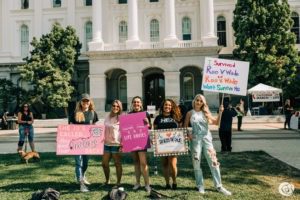
On August 25th, we gathered in Sacramento for the first-ever California March for Life. We encouraged hundreds of marchers to contact their local lawmakers about a radical, pro-abortion bill that would have forced health insurance providers to pay for abortions in their entirety, and the bill was halted THE VERY NEXT DAY!

Virginia March for Life
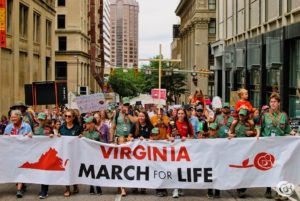
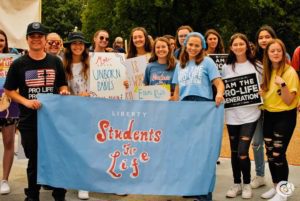
On September 17th, we hosted the third-annual Virginia March for Life in Richmond, VA. For our longest-running State March, we were joined by hundreds of pro-life Virginians to stand up against pro-abortion extremism and promote voter registration ahead of an important election season.
Pennsylvania March for Life
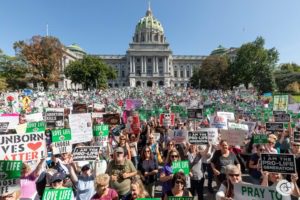
On September 27th, we saw our largest State March crowd this year at the first-ever Pennsylvania March for Life. PA State Representative Kathy Rapp, who has been in office for well over a decade, remarked on stage that it was “the largest rally [she] has ever seen in Harrisburg.” Even Pennsylvania’s pro-choice governor saw the crowd and responded against their pro-life witness!
Beautiful weather paired with the courageous presence of pro-life lawmakers on stage and powerful testimonies from abortion-healed speakers like Toni McFadden and Abby Johnson made the day as impactful as it was.

There is one reason why these State Marches are so beautiful and so fruitful: you. We are honored to march beside you and give joyful witness to the beauty of life. Thank you for marching with us. Each step brings us closer to each other and to the day when the heartbreak of abortion will be unthinkable.